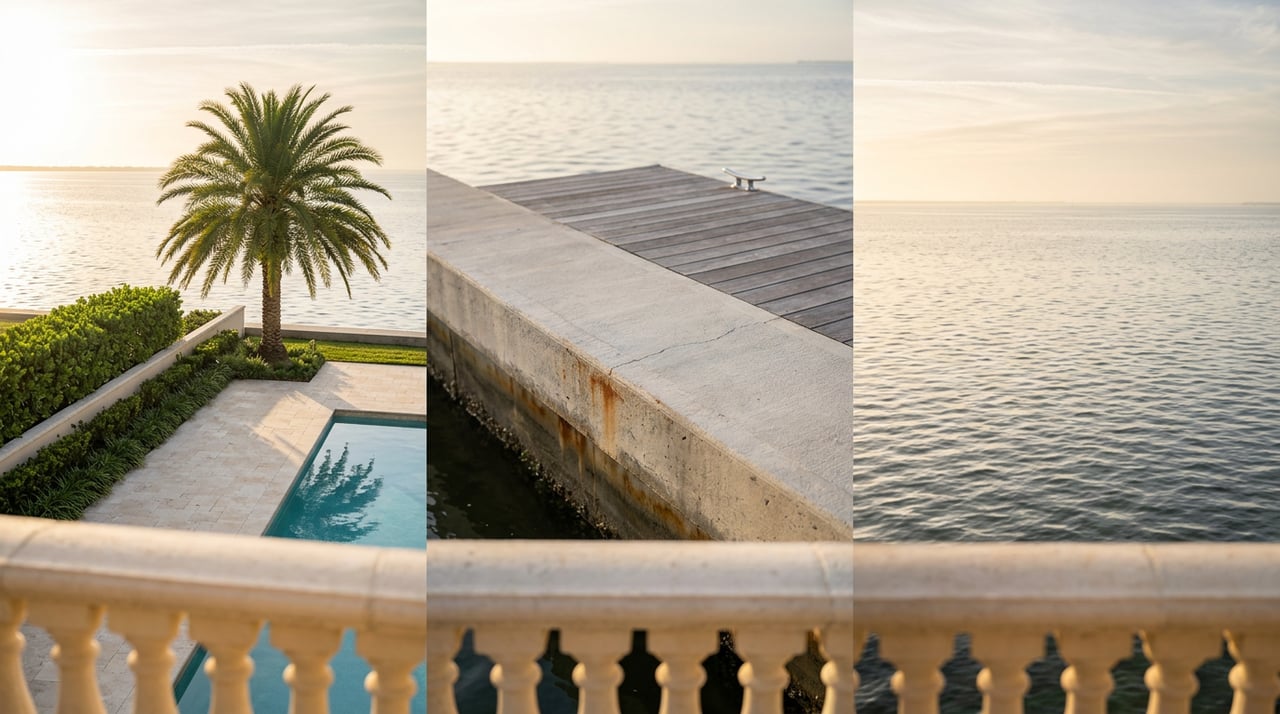
By the time Hurricane Helene finished with it, the Fire Marshal Dick Brock Memorial Pier in Safety Harbor was gone. Not damaged, not closed for repairs like it had been weeks earlier after Hurricane Debby. Gone, down to the pilings, a structure that had anchored the city's waterfront for generations reduced to posts in the water. Mayor Joe Ayoub put it plainly, as WUSF reported: "it no longer really functions as it was intended to function."
That $2.7 million rebuild is still underway as of this fall, and it is worth pausing on before it wraps up, because the pier was never the only structure at risk. It sat next to a seawall, and that seawall took the same storms. If a municipal structure engineered to public standards and maintained on a city budget could be destroyed by the 2024 hurricane season, a private seawall down the block, built decades earlier and maintained on whatever schedule an individual owner chose, deserves an honest look before it goes on the market. That is the argument this post is making, and it runs straight into a gap in Florida's paperwork that most sellers never think to check.
A Public Repair Bill Both Sides Can See
The city approved its contract with Shoreline Foundation Inc. on May 19, 2025, and construction started that July 7. The project was already years in motion by then. Mayor Ayoub has said design work on the replacement traces back to 2020, years before anyone knew what the 2024 storm season had in store. Hurricane Debby forced the pier's closure first. Helene finished the job a few months later. What had been a planned, orderly replacement became a rebuild under emergency conditions, funded through a mix of city money, state contribution, and hoped-for FEMA support.
As of the city's own recovery updates this September, the marina's electrical work is still being completed and the contractor has until the end of December 2026 to finish. That is a long runway for a structure that, from the shoreline, has looked mostly finished for months. The city itself has said as much: what looks done from the parking lot still has punch-list items, permit closeout, and inspection steps left to clear.
The lesson for a private waterfront owner isn't about the pier itself. It's about what sits underneath and beside it. A seawall built to hold back Old Tampa Bay is a structural system, and structural systems fail on their own timeline, not on the timeline of a listing photo shoot.
The Form Buyers Actually Sign
Since October 1, 2024, Florida law has required sellers of residential property to hand buyers a written flood disclosure before or at the time the sales contract is signed. The state expanded that requirement again on October 1, 2025, adding disclosure duties for landlords and condominium developers as well.
Here is what that form actually asks. It wants to know whether you have ever filed an insurance claim for flood damage. It wants to know whether you have received government or private flood assistance. The form also covers flood damage.
Read that list again and notice what isn't on it. Nothing asks about the age of your seawall. Nothing asks about the material, whether it's concrete panel or vinyl sheet pile. Nothing asks whether a marine contractor has ever flagged a crack in the cap, a lean out of plumb, or a section that has quietly started to separate from the fill behind it. A seller can answer every question on the state's flood form honestly, mail it back, and still be sitting on a wall with a real problem the form never asked about.
| What the flood disclosure form asks | What it leaves out |
|---|---|
| Whether you filed an insurance claim for flood damage | Seawall age, material, or last inspection date |
| Whether you received flood assistance | Visible cracking, leaning, or cap displacement |
| Flood damage history | Whether a marine contractor has ever flagged the wall |
That gap is not a loophole a seller can rely on. It's just a blind spot in one specific form. A different, older rule fills it.
The Older Rule That Still Reaches It
In 1985, the Florida Supreme Court decided Johnson v. Davis, a case about a leaking roof the sellers knew about and never mentioned. The court rejected the old buyer-beware standard for home sales and put an affirmative duty on sellers instead. Where a seller knows of facts that materially affect a property's value, and those facts aren't things a buyer would readily discover on their own, the ruling held "the seller is under a duty to disclose them to the buyer."
Three things have to be true for that duty to apply. The seller has to actually know about the issue. The issue has to be significant enough to affect value, not a cosmetic scratch. And it has to be something a buyer couldn't reasonably spot by walking the property or during a normal inspection. A seawall that looks fine above the waterline but has a documented history of repair, or a wall the seller has personally watched shift after a storm, tends to fit that description.
This duty exists independent of any state form and independent of an as-is contract. The Florida Bar explains that Florida courts have consistently held that an as-is clause doesn't erase a seller's obligation to disclose a known, material defect. The flood disclosure form is new. The obligation underneath it, when it comes to something like a seawall, has been settled law in Florida for four decades.
Why This Matters More on This Side of the Bay
Safety Harbor's waterfront isn't uniform, and that's part of what makes this worth spelling out rather than treating as boilerplate advice. Neighborhoods like Espiritu Santo Springs and the homes along Bayshore Drive sit directly on Old Tampa Bay, close enough to walk to the marina and Philippe Park, with many properties built well before current storm-design guidance existed. A seawall installed decades ago wasn't built to the same standard the city is now building to as part of its own rebuild, and it hasn't necessarily been inspected since.
That doesn't mean every private wall in the neighborhood is compromised. It means the city just gave every waterfront owner nearby a very public, very expensive demonstration of what happens when a structure like this meets a storm pattern like the one Pinellas County lived through in 2024. Treating that as background noise, rather than as a reason to check the private version of the same structure, is the kind of gap that tends to surface at exactly the wrong moment in a transaction, during a buyer's inspection period rather than before the home ever goes on the market.
The Inspection That Changes the Conversation
The practical move is straightforward. Before listing a waterfront home in Safety Harbor, have the seawall looked at independently, separate from a general home inspection, by someone whose job is specifically marine structures. That report becomes part of the seller's own knowledge base going into disclosure, and it puts the seller in control of when and how the seawall conversation happens rather than leaving it to whatever a buyer's inspector finds first.
Costs vary by market and by the scope of work, but in other Gulf Coast markets, a pre-listing marine inspection has typically run in the low hundreds of dollars and taken under two hours for a standard residential lot. Full replacement, when it's actually needed, is usually quoted per linear foot rather than as a flat number, and the spread between materials and site conditions can be wide. That range is exactly why finding out early, on your own terms, is worth more than finding out during a buyer's option period, when the number on the table is one you didn't choose.
Does selling as-is get me out of disclosing a seawall problem? No. Florida courts have held that an as-is clause does not remove a seller's common-law duty to disclose a known, material defect that a buyer wouldn't otherwise discover.
If I've never filed a flood insurance claim, am I in the clear? A clean claims history answers only the form's question about claims; the form also asks about flood assistance and flood damage history. It doesn't by itself satisfy the separate Johnson v. Davis duty if you otherwise know your seawall has an issue the form never asked about.
Selling a waterfront home in Safety Harbor means understanding both what the paperwork requires and what it quietly doesn't. Kirsten Kelley works with waterfront sellers across Pinellas County on exactly this kind of pre-listing groundwork, from lining up the right marine inspection to making sure disclosure gets handled correctly the first time. If you're weighing a listing on the water this fall, schedule a consultation before you sign anything.
This article is general information, not legal, tax or financial advice. Consult a qualified professional about your situation.